
Box Canyon Jeep Trail: Colorado's Most Scenic Slot Canyon Drive
Understanding Box Canyon and What Makes It Different
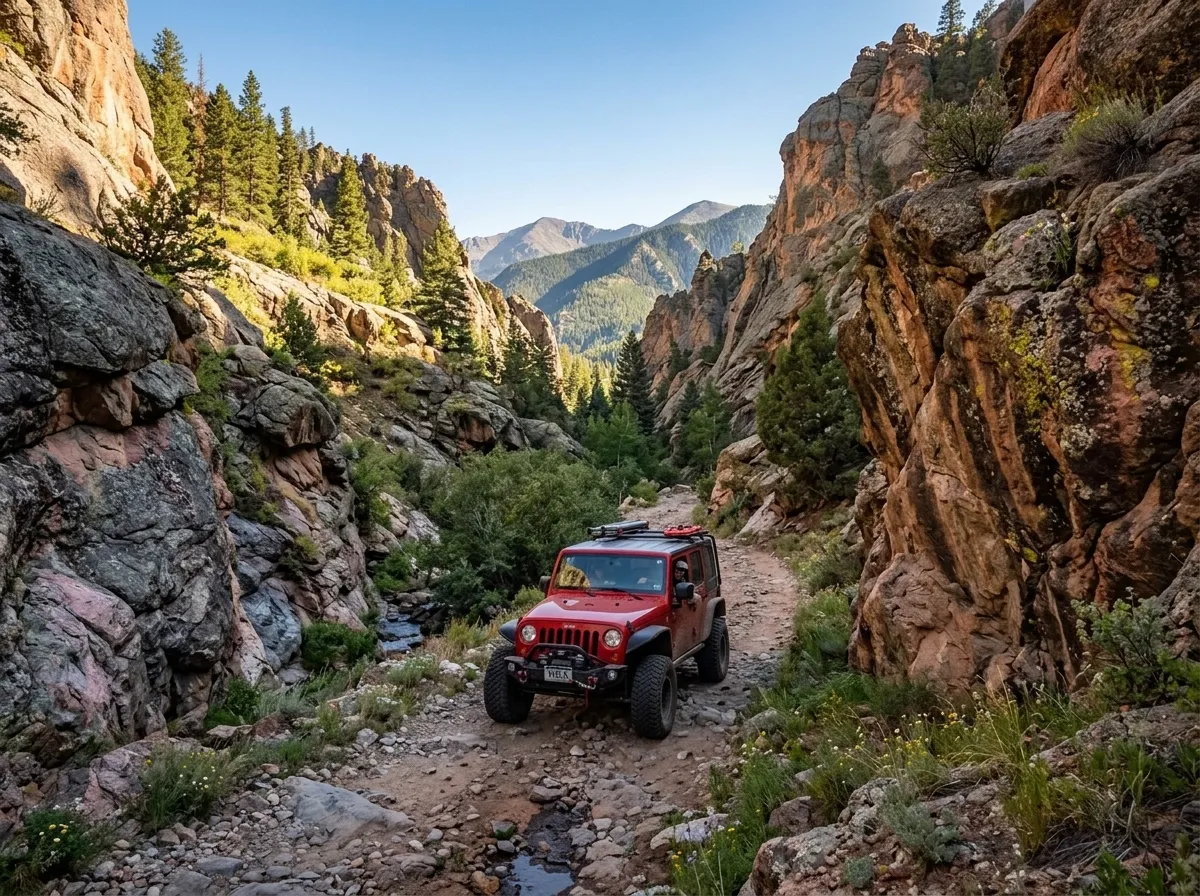
Box Canyon sits in southwestern Colorado near Ouray. It's a genuine slot canyon—terrain where the landscape narrows to a confined passage, rock walls rising on both sides, the sky visible as a stripe overhead. Most Jeep trails offer views and challenge. Box Canyon offers something else: the sensation of moving through terrain that demands your full attention because the landscape itself is doing the demanding.
A slot canyon isn't a marketing phrase. It's a geological reality. Water carved through rock over millennia, creating passages that are sometimes only wide enough for a single vehicle, walls rising high enough that sunlight doesn't reach the bottom for much of the day. Box Canyon is one of Colorado's most accessible examples of this terrain.
What separates this trail from typical Jeep routes is the combination of confinement and technical challenge. You're not just driving difficult terrain. You're driving difficult terrain in a space where error margins are measured in feet, not yards. The landscape forces honesty. You either have the skill and vehicle capability to navigate it, or you don't.
This guide walks through what Box Canyon actually involves. It explains what you need to prepare, what the terrain demands, and honestly assesses whether this drive fits your situation. It's not about convincing you to attempt something beyond your capability. It's about giving you the information to make a smart decision.
Box Canyon: Location, Access, and Geology
Box Canyon sits near Ouray, Colorado, in the San Juan Mountains. The canyon itself is roughly ten miles outside town, accessible via Forest Service roads that approach from multiple directions depending on which route you take. The terrain around Ouray is high alpine—elevations ranging from 8,000 to 10,000 feet—which means altitude affects both your body and your vehicle.
The geological story of Box Canyon tells itself in the rock walls. The canyon was carved by water working through layers of stone, grinding away softer material and leaving harder formations behind. What you see driving through is millions of years of erosion concentrated into a passage that narrows to points where the rock walls feel like they're closing in.
The canyon's dimensions vary. Some sections open to reasonable width. Other sections tighten dramatically. At the narrowest points, you're in genuine slot canyon terrain. The rock walls rise vertically, sometimes 100 feet or more. The sky becomes a thin line overhead. The landscape surrounding you is imposing not because it's trying to be, but because geology doesn't negotiate.
Slot canyon geography and Box Canyon's specific formation:
Water erosion carved the primary passage over geological time
Multiple layers of rock with varying hardness created the uneven floor
Walls rise in some sections more than 100 feet
Widths vary from roughly 15-20 feet in open sections to less than 10 feet at the narrowest
The canyon floor is primarily rock with dirt and sand accumulation in sections
Flash flood potential exists during and after rain, even distant rain
The landscape tells a story if you're paying attention. You're not just driving through a place. You're driving through evidence of time and water and geology working together.
Keep In Mind: Box Canyon isn't a hidden secret. It's a known trail with real hazards. Understanding the geology helps you understand why those hazards exist and how to respect them.
Why Box Canyon Demands Your Attention
Box Canyon stands apart from typical high-altitude Jeep trails because it combines several challenges that don't usually appear together. You have altitude effects, technical terrain, confinement, and water hazards all in one route. That combination creates an experience that's genuinely different from driving any standard trail.
The confinement itself is significant. Most Jeep trails, even technical ones, allow you to see what's coming. You can spot obstacles from a distance. You can plan your line through sections before you reach them. Box Canyon doesn't offer that luxury. The canyon walls close in. Visibility becomes limited. You're making decisions about line selection based on what you can see in the immediate moment.
Technical challenge on Box Canyon involves:
Narrow passages requiring precise vehicle placement
Rock gardens and boulders blocking direct routes
Steep grades in confined sections where escape options are limited
Water crossings that vary by season and recent weather
Slickrock sections where traction demands technique
Switchbacks and tight turns in restricted space
What separates this from easier terrain is that mistakes have immediate consequences. Getting stuck or high-centered in a narrow section means recovery is complicated. Your options for repositioning are limited. Outside help takes time to reach you.
The sense of scale changes as you move through the canyon. Initially, the rock walls are impressive but manageable. As the canyon tightens, the landscape feels increasingly confining. Some drivers find this intensely rewarding. Others find it genuinely uncomfortable. That reaction is legitimate information about whether this drive is appropriate for you.
The intimacy of confined terrain creates a different kind of engagement with the landscape. You're not admiring views from a distance. You're navigating space where the rock is immediately present. Your awareness of the vehicle's dimensions becomes acute. Your focus becomes singular.
Think of it this way: Box Canyon isn't difficult because it's trying to be difficult. It's difficult because the geology creates constraints that demand respect and capability.
Box Canyon Terrain and Trail Characteristics
Box Canyon doesn't follow a single defined route. Instead, it's a general area with multiple ways to approach and exit, creating options for different loops or out-and-back configurations. Total distance typically runs between 8-12 miles depending on which variation you take.
The elevation profile shows steady climbing as you approach the canyon, then sustained altitude once you're navigating through it. Most starting points sit around 8,500-9,000 feet. The canyon itself ranges from 9,500 to 10,500 feet depending on which section you're in. That altitude affects engine performance and your physical response to exertion.
Terrain composition varies throughout Box Canyon:
Initial approach: rough dirt road, increasingly rocky as you climb
Canyon entrance: transition from open terrain to confined space
Mid-canyon sections: primarily rock with some sand accumulation
Technical sections: rock gardens, boulders, water-worn stone
Water crossings: seasonal variation from manageable to significant
Exit: either reverse route or loop option depending on your approach
The canyon floor is primarily exposed rock, worn smooth in sections by water and traffic, irregular in others with boulders and obstacles creating the technical challenge. Sand and dirt fill some areas, particularly after water flow sections. The composition changes seasonally based on recent precipitation and snowmelt.
Water crossings on Box Canyon range from manageable to serious depending on when you attempt the drive. Summer conditions often show minimal water. After heavy rain or during spring snowmelt, stream levels rise significantly. The canyon's confined space means water has nowhere to disperse—it concentrates and flows with force.
The narrowest sections of Box Canyon are what make the trail memorable. At these points, the canyon walls come close enough that you're genuinely aware of the vehicle's width. The psychological experience shifts. You move from managing technical terrain to managing confinement.
Remember: Box Canyon's terrain isn't random difficulty. It's geology expressing itself through a passage shaped by water and time. Understanding what created the terrain helps you understand what you're actually navigating.
Vehicle Requirements for Box Canyon
Box Canyon isn't accessible in standard vehicles, and it's not accessible in stock Jeeps either. This trail requires genuine 4x4 capability with specific features that matter.
Ground clearance becomes critical on Box Canyon. The canyon floor has rocks protruding irregularly. Boulders that look passable can high-center a vehicle if the approach angle is wrong. You need minimum ground clearance of 10 inches, ideally more. Any skid plates protecting your undercarriage should be robust—rock impacts at altitude happen at speed and force.
Vehicle requirements for safe navigation of Box Canyon:
High-clearance 4x4 with proven capability on technical terrain
Ground clearance minimum 10 inches, preferably 11-12
Locking differentials front and rear
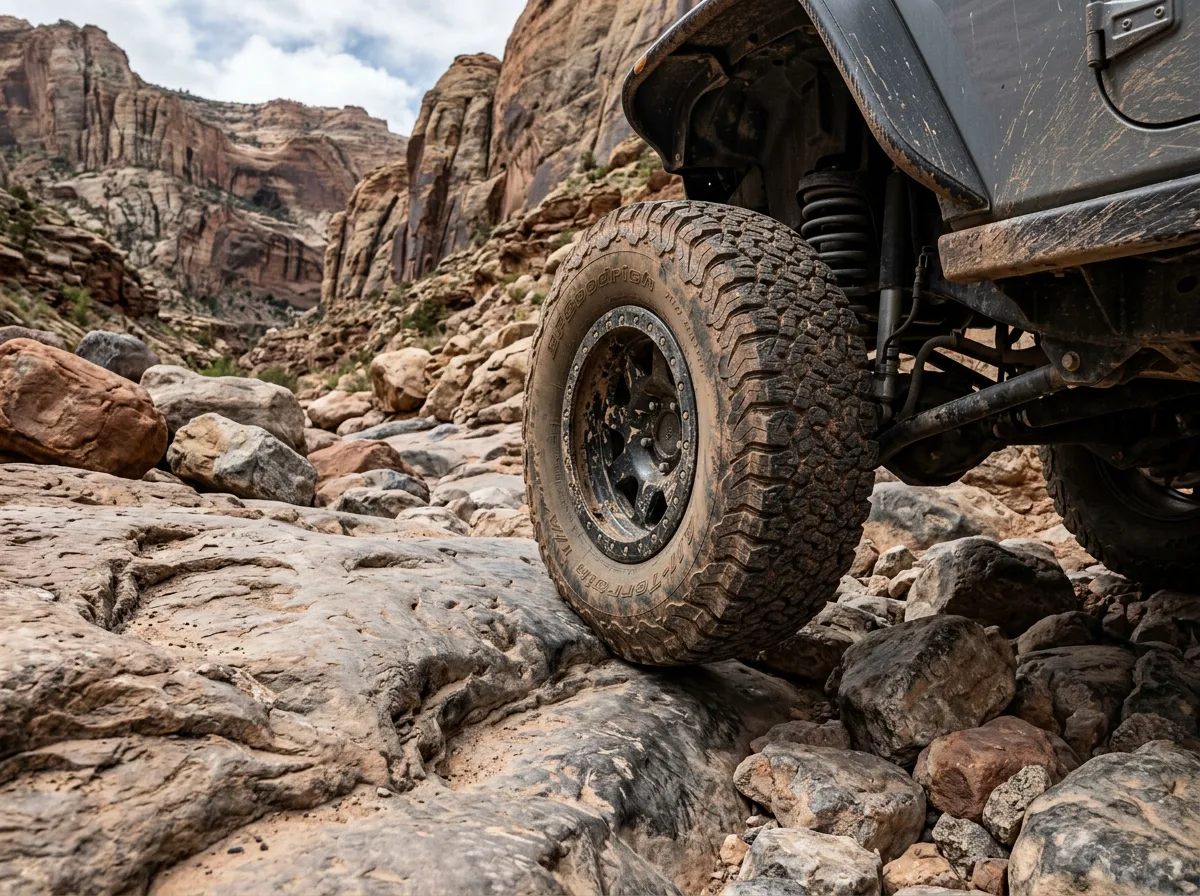
Aggressive tread tires designed for rock, not all-terrain street tires
Durable suspension that handles rock impacts without bottoming
Protective skid plates covering engine, transmission, transfer case
Good approach and departure angles for climbing boulder sections
Strong bumpers and recovery points for winching if needed
Tire selection matters significantly. All-terrain tires designed for highway use perform poorly on rock. You need tires with aggressive lugs specifically designed for rock crawling. Tire pressure adjustment—lowering pressure slightly on rocks to increase traction—requires understanding how to do this safely and knowing how to re-inflate afterward.
Locking differentials aren't optional on Box Canyon. The technical sections demand traction control that standard differentials can't provide. Without them, wheels will spin uselessly on rock where solid contact matters.
Recovery gear and why it's essential includes winches, recovery straps, shackles, snatch blocks, and D-rings. If you get stuck in a narrow section, professional recovery means waiting for a specialized vehicle to reach you in terrain where access is difficult. Self-recovery with proper equipment means solving the problem yourself.
The Bottom Line: Box Canyon requires a vehicle that's been set up specifically for technical terrain. Stock vehicles of any brand won't cut it. The canyon doesn't grade on effort or intention. It grades on capability.
Difficulty Level and Skill Requirements
Box Canyon ranks as advanced-to-expert terrain. This isn't a trail for drivers new to rock crawling. This is a trail for drivers who have tackled multiple technical routes and understand their own capabilities.
The technical difficulty comes from several sources: narrow passages require precise vehicle placement, rock sections demand understanding of how different parts of your vehicle interact with terrain, water crossings add unpredictability, and confinement limits options if something goes wrong.
What previous trail experience helps:
Multiple technical trails in various terrain types
Rock crawling on comparable or harder trails
Experience with water crossings at significant depth
Comfort making line selections under pressure
Understanding vehicle geometry and breakover angles
Recovery experience and knowing how to use recovery gear
Solo driving on remote terrain without panic responses
This isn't about being tough or brave. It's about having practiced the specific skills that matter. A driver who's spent time learning rock crawling on less demanding trails has developed instincts that apply here. A driver jumping directly to Box Canyon is learning under pressure in a place where mistakes are expensive.
Honest assessment of your capability matters more than ego. The question isn't whether you want to do this drive. The question is whether you have the actual skills and the vehicle capability to do it safely. Those are separate things.
When to skip Box Canyon and choose other terrain includes: if your vehicle lacks necessary capability, if your driving experience hasn't included technical rock crawling, if weather threatens any possibility of water issues, if you're unsure about your ability, or if this is your first high-altitude trail attempt. All of these are legitimate reasons to choose different routes.
Keep In Mind: Box Canyon will still exist next year. Choosing to wait until you have more experience and a better-equipped vehicle is wisdom, not weakness.
Seasonal Conditions and Access Windows
Box Canyon is accessible during a limited window. The trail requires late-spring through early-fall conditions for safe driving. Winter closures are real. Attempting Box Canyon outside the safe season creates unnecessary hazard.
Summer conditions represent the peak season. July through September offer the most stable weather and lowest water levels. Monsoon season brings afternoon thunderstorms and flash flood risk, but these are usually brief and avoidable if you pay attention to weather.
Fall driving in September and early October works well. The monsoon risk decreases. Temperatures cool. The crowds from peak summer diminish. Fall conditions often represent the best window for Box Canyon.
Spring conditions depend on snowmelt timing. May and June can work if snowmelt is finishing, but water levels may be high. Early spring often means the canyon remains too wet or access roads haven't dried sufficiently.
Winter closure is standard. Snow and ice make the canyon inaccessible. Even if the roads are passable, the canyon itself becomes genuinely dangerous. Don't attempt Box Canyon in winter.
Seasonal water level variations on Box Canyon:
Summer: Stream levels manageable, crossings possible without major difficulty
Monsoon season: Flash flood risk, but usually brief afternoon storms
Fall: Declining water levels, most stable conditions overall
Spring: Highest water levels from snowmelt, most unpredictable
Winter: Closure—snow, ice, and avalanche danger make driving impossible
Flash flood danger in canyon terrain is real and specific to this environment. Water concentrates in the canyon and flows with force. Distant rain upstream can create dangerous conditions in the canyon itself. Lightning risk increases during monsoon season. If weather threatens, exit immediately.
The Bottom Line: Box Canyon has a short safe season. Attempting it outside that window isn't adventurous. It's reckless. Work within the seasonal reality.
The Drive: Terrain Section by Section
The approach to Box Canyon begins on Forest Service roads that gradually become rougher. Initial driving allows you to assess conditions and your vehicle's response. Nothing at this stage is shocking, but the terrain is clearly working toward something more serious.
As you climb elevation, the landscape changes. Trees thin. Rock outcrops become more common. You're transitioning from general mountain terrain to the specific geology that creates Box Canyon.
Entry to the canyon itself marks a significant shift. The rock walls begin closing in. Visibility ahead becomes limited. The canyon walls narrow progressively. Your awareness of vehicle dimensions becomes acute. This is where concentration shifts to serious focus.
The canyon at its widest offers reasonable driving space. You still have room to maneuver. Rock obstacles exist, but you have options for line selection. The technical sections are present but manageable if you're paying attention.
Mid-canyon sections show increasing confinement. The walls come closer. Shadows deepen from the reduced sky opening. The sound changes inside the canyon—your engine note echoes off rock. The psychological effect is real: you're inside terrain rather than driving through it.
Water crossings appear at intervals depending on season and recent weather. In summer conditions, you might cross modest streams that are easily handled. In spring or after heavy rain, these same crossings become serious obstacles. The confined space means water has nowhere to disperse. Stream force concentrates and flows with velocity.
The narrowest sections of Box Canyon represent the peak technical challenge. The rock walls come close enough that passing a vehicle in the opposite direction becomes impossible. If you meet someone, one of you backs out. Your vehicle placement matters because the canyon doesn't give you margin. Every decision about line selection has real consequences.
Technical sections demand specific technique: approach at controlled speed, read the terrain ahead, commit to your line once you've decided, trust your vehicle's capability, and move through smoothly without hesitation. Tentative driving in confined terrain is actually more dangerous than confident driving—you stall, lose momentum, get stuck.
Exit from Box Canyon varies depending on your route. If you've done an out-and-back, you reverse the approach. If you've planned a loop, the exit uses a different route. Either way, leaving the confined space creates an odd sensation—the sky widens, the landscape opens, you realize how constrained you were inside.
The views from Box Canyon aren't postcard vistas from a distance. They're the intimate geology of confinement. The rock itself is the view. Understanding what you're looking at—the layers of stone, the water erosion patterns, the color variations—adds meaning to the drive.
Remember: Box Canyon is experienced, not observed. You're not driving through a place and admiring it. You're navigating it.
Safety Considerations Specific to Box Canyon
Hazards specific to slot canyon driving include flash flood danger, vehicle entrapment risk, mechanical failure in remote terrain, and confinement-induced stress.
Flash flood danger is real and requires serious attention. Even if the sky above Box Canyon is clear, rain miles upstream creates hazard. Water concentrates in the confined space. Stream levels rise quickly. If you're in the canyon when water rises, escape options are limited. If you see dark clouds building or hear thunder, exit immediately. Don't gamble on storm timing.
Vehicle entrapment concerns include getting high-centered on a boulder, getting stuck in a section where you can't drive forward or backward, or mechanical failure that prevents movement. Recovery in confined space is complicated and expensive. Professional recovery vehicles have difficulty accessing canyon terrain. Self-recovery with proper equipment becomes essential.
Mechanical failure in Box Canyon isn't just inconvenient. It's a serious situation. You're hours from town. Cell service is spotty at best. If your vehicle breaks down, you're managing a recovery operation in difficult terrain.
Confinement-induced stress affects some drivers. The narrow passages and confining rock walls create genuine psychological pressure. Some drivers love this. Others find it uncomfortable. Neither response is wrong. It's legitimate information about whether this drive fits your mental space.
Communication on Box Canyon is limited. Cell service may work, but don't count on it. Satellite communicators provide backup. Tell someone where you're going and when to expect you back. Plan for self-sufficiency.
Safety decisions on Box Canyon require honesty:
Turn back if weather threatens
Exit immediately if you see any signs of water rising
Don't continue if mechanical issues appear
Acknowledge if confinement stress is becoming too much
Stop and reassess if you're unsure about line selection
Call for help if you become stuck and can't self-recover
The most important safety decision is making conservative calls in real time. The canyon will still exist next visit. Your safety matters more than reaching a destination.
Think of it this way: Box Canyon respects drivers who respect it. Drivers who push beyond appropriate limits get reminded about the canyon's reality in expensive ways.
Preparation and Essential Gear
Vehicle preparation before Box Canyon is non-negotiable. Check all fluid levels—engine oil, coolant, transmission fluid, brake fluid. Verify battery condition (altitude and cold affect performance). Check tire condition and pressure. Test all four-wheel drive systems. Verify locking differentials function properly.
Recovery gear for Box Canyon includes:
Winch with adequate capacity and proper rigging
Recovery straps rated for your vehicle weight
Shackles and D-rings for secure attachment
Snatch blocks for mechanical advantage
Basic tool set (sockets, wrenches, screwdrivers)
Jumper cables and battery charger
Tire repair supplies and plug kit
Extra oil, coolant, transmission fluid
Spare belts and radiator hose
Duct tape and zip ties for emergency repairs
Water and hydration for Box Canyon driving requires bringing more than you think you need. At altitude, you dehydrate faster. Sustained concentration in confined terrain increases water needs. Bring at least four liters per person. Electrolyte replacement matters—plain water alone doesn't address desert dehydration.
Navigation tools for Box Canyon include a detailed map of the area, GPS device or smartphone with offline maps, and knowledge of the route. The canyon itself has established routes, but knowing your options and bailout points matters. Maps showing Forest Service roads let you understand where you are if you need to exit via alternate route.
Food and energy for the full drive means bringing actual lunch and snacks. Bring meals with protein and calories. Your body is working—from altitude, from concentration, from managing vehicle through technical terrain. Energy management matters.
First aid and emergency supplies should include comprehensive first aid kit beyond basic bandages, pain medication, altitude sickness medication if prone, blister treatment, antibiotic ointment, and anything for personal medical needs.
Proper footwear and clothing for Box Canyon matters. Sturdy hiking boots with ankle support and good grip handle walking on rock. Bring long sleeves and pants for sun protection and against scraping rock. Bring a wide-brimmed hat, sunglasses with UV protection, and sunscreen. Bring a light jacket for temperature variation.
If you're renting a Jeep from Cliffhanger for Box Canyon, we can help you ensure the vehicle is properly equipped and you understand all its systems. Contact us and we'll walk through what makes sense for your specific situation and trip plans.
Best Times and Planning Your Visit
Box Canyon works best during the window from mid-June through mid-September. Peak season is July and August. Fall September and early October offer ideal conditions with fewer crowds.
Time of day considerations matter for Box Canyon. Starting early gives you daylight for the drive and daylight to handle any issues that arise. Afternoon starts in the canyon mean potentially dealing with problems in fading light.
Weather monitoring before you commit is essential. Check forecasts for Box Canyon area and upstream locations. Avoid driving if precipitation is predicted. Monsoon season brings afternoon thunderstorms—if weather threatens, start early and plan to finish before afternoon storms develop.
Nearby accommodations include Ouray, which offers hotels, motels, and vacation rentals. Smaller towns like Ridgway offer other options. Plan lodging in advance, particularly during peak summer season.
How to structure a trip combining Box Canyon with other drives includes recognizing that Box Canyon is demanding. Combining it with other technical trails on the same day is pushing beyond reasonable limits. Better approach: dedicate a full day to Box Canyon, keep it as your only significant technical drive that day, explore other attractions on other days.
Multi-day itineraries in the region might include Box Canyon on day one, then gentler routes or non-driving exploration on following days. This allows recovery and prevents fatigue accumulation.
Keep In Mind: Box Canyon demands full attention and energy. Structure your trip to make this the primary activity, not an add-on to other ambitious plans.
The Experience and What Box Canyon Delivers
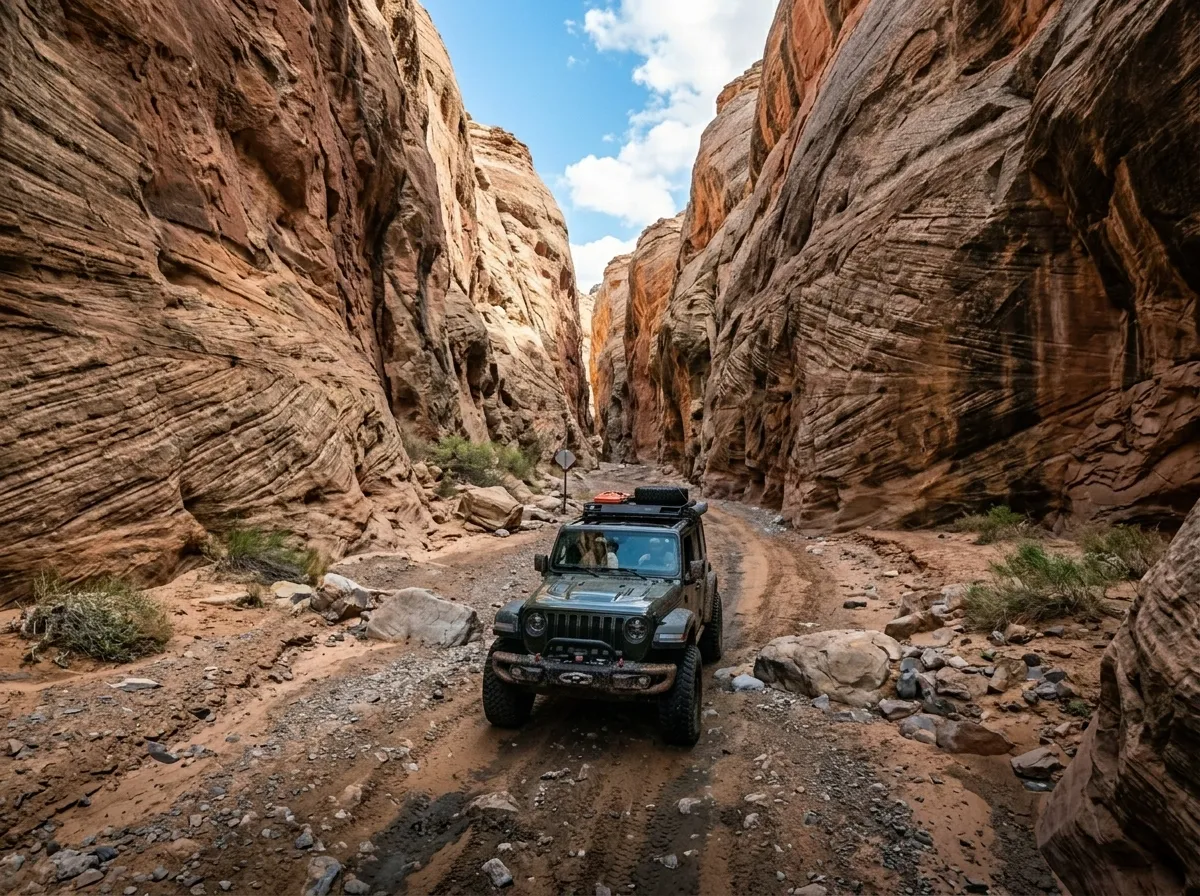
Driving through a slot canyon creates a sensation distinct from other trail driving. Confinement forces presence. The landscape is immediately around you, not distant. Your awareness of vehicle dimensions becomes acute. Your focus becomes singular.
Physical sensation includes the constrained space, the echo of engine noise off rock walls, the changing light as the sky narrows above you, the vibration of rock below tires. These sensations are vivid because they're direct contact with geology.
Clarity that comes from technical focus on Box Canyon is genuine. When you're concentrated on line selection through confined terrain, everything else disappears. The demands of the drive consume attention completely. That kind of presence is rare in daily life.
The landscape's scale in confined space is paradoxical. The rock walls are imposing, but only because you're intimate with them. The confinement makes the geology feel larger, not smaller. You're not admiring from distance. You're inside the formation.
Why people return to Box Canyon and seek similar challenges relates to the experience itself. The drive validates capability. You tested yourself and succeeded. That satisfaction carries beyond the drive itself.
How Box Canyon compares to other Colorado trails is that it's genuinely unique. You can find technical terrain elsewhere. You can find high altitude elsewhere. Finding genuine slot canyon driving in Colorado is less common. This combination creates something distinct.
What you learn about your vehicle includes its actual capabilities and limits. What it handles and what it struggles with becomes clear. What you learn about yourself includes whether you have genuine comfort with confined terrain, whether your skills are actually at the level you believed, and what your response is under pressure.
The Bottom Line: Box Canyon isn't about completion or bragging rights. It's about the experience of driving terrain that demands respect and capability. The value is in the doing, not in having done.
Closing Thoughts on Box Canyon
Understanding Box Canyon and respecting what it demands changes your approach entirely. This isn't a trail to attempt casually or with uncertain preparation. It's a trail that rewards genuine preparation and punishes shortcuts.
Why preparation and respect matter more than ego comes down to practical safety. You can be courageous and still make conservative decisions. You can be committed and still acknowledge when conditions exceed your capability. You can push your limits intelligently rather than recklessly.
Connection between challenge and genuine experience is real on Box Canyon. Easy drives are nice. Challenging drives that demand your full presence create experiences that stick with you. The clarity that comes from being genuinely engaged with difficult terrain has value beyond just checking a box.
Honest assessment of whether Box Canyon fits your situation requires answering difficult questions. Do you have the vehicle capability? Do you have the driving experience? Do you have adequate recovery gear? Are you comfortable with confined terrain? Can you make conservative decisions when conditions warrant? If the answer to most of these is yes, Box Canyon might be appropriate. If several are no, other trails serve you better.
If you're considering renting a vehicle from Cliffhanger to attempt Box Canyon, we can help you evaluate whether the drive matches your capability and help you prepare appropriately. Contact us and let's discuss what makes sense for your experience level and trip plans.
The mountains respect preparation. Box Canyon is no exception. Show up ready, drive with focus, and you'll experience something genuinely worth the effort. Push beyond appropriate limits, and the canyon will remind you about the reality of terrain that doesn't negotiate.